

The leadership management gap is the widening distance between what senior leadership intends and what management actually delivers – and it is one of the most expensive, invisible problems in modern
organizations.
It develops gradually, through structural silos, filtered communication, and misaligned incentives. Left unaddressed, it quietly drains engagement, trust, and performance.
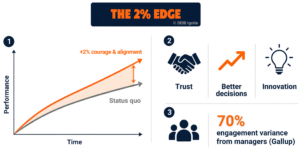
Closed deliberately, it becomes a genuine competitive edge: the 2% edge that separates organizations that execute from organizations that merely plan.
The direct answer to why this gap exists and often continues to grow is this: the divide grows because each layer of the organization optimizes for different information, different pressures, and different behavioral drives and because most organizations never make the gap visible.
What Is the Leadership Management Gap?
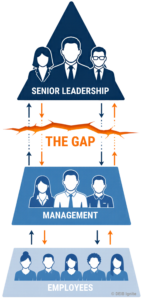 The leadership management gap is the structural and behavioral distance between senior leadership and the management layer beneath it. It shows up as misaligned priorities, filtered or distorted communication, inconsistent decision-making, and managers who experience the executive agenda as disconnected from operational reality.
Two things distinguish it from ordinary hierarchy:
First, every organization has layers – but not every organization has a divide between them. Layers become a gap when information stops flowing honestly in both directions.
Second, the gap is behavioral, not just structural. It is shaped by how leaders and managers are naturally wired – their drives toward dominance, extraversion, patience, and formality – and by whether the
organization gives them a shared language for understanding those differences.
This is precisely where behavioral profiling through tools such as the Predictive Index becomes the 2% edge. When both senior leaders and managers can see their own behavioral drives and each other’s, the
distance between levels stops being an invisible source of friction. Instead, it becomes a visible, workable alignment challenge.
Furthermore, the gap is not a talent problem. Most senior leaders are extraordinarily capable. Most managers are too. And yet, time and again, the two levels talk past each other. Strategy is set at the top, diluted in the middle, and experienced at the front line as confusion or contradiction. That is what the leadership management gap looks like when it is left to grow. For the full foundation on closing it with behavioral data, explore our article: Behavioral Profiling for Success: The 2% Edge Explained.
How the Leadership Management Gap Develops
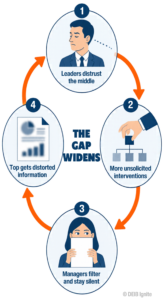
The leadership management gap does not appear overnight – it develops through a series of predictable, compounding dynamics. The earlier you recognize them, the cheaper they are to fix. Understanding these root causes is the first step toward deliberately closing the divide.
The Filtering Effect
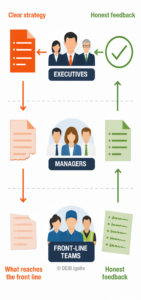
Every layer between the executive team and the front-line filters information. Managers soften bad news on the way up and dilute strategy on the way down. Over time, senior leaders make
decisions on a sanitized picture of reality, while managers execute a blurred version of the strategy. Nobody lied intentionally. The gap simply grew, one filtered message at a time.
Different Pressures, Different Realities
Senior leadership is accountable for long-term direction, board expectations, and market positioning. Managers are accountable for daily execution, team wellbeing, and immediate results. These are not just different tasks – they are different cognitive and emotional environments. The divide deepens when neither side receives genuine insight into the other’s daily reality.
Misaligned Incentives
If senior leadership is rewarded for transformation speed and managers are rewarded for stability, the organization has quietly built the gap into its own pay and performance systems. Managers rationally protect their teams from disruption. Senior leaders rationally demand it. Without aligned incentives and honest dialogue, both behaviors appear as resistance or arrogance from the other side.
 Unsolicited Interventions and Trust Erosion
One of the most corrosive gap-builders is unsolicited intervention from the top. When senior leaders bypass or override managers – restructuring teams, overriding decisions, or messaging front-line staff directly – they signal that the management layer does not matter. Managers stop feeling safe, stop advocating honestly upward, and start filtering aggressively to survive. The divide becomes self-reinforcing. This dynamic connects directly to the patterns explored in Combating Leadership Toxicity: A Behavioral Toolbox.
The Behavioral Blind Spot
Finally, the gap develops because leaders and managers rarely understand their own behavioral differences. A senior leadership team dominated by high-dominance, low-patience profiles will move faster and push harder than a management layer rich in patience and formality. Neither profile is wrong – but without awareness, the top reads the middle as slow and resistant, while the middle reads the top as impulsive and reckless. Behavioral profiling makes these dynamics explicit, valid, and actionable.
Why the Leadership Management Gap Widens Over Time
The leadership management gap does not stay stable when left unaddressed – it compounds. Four dynamics accelerate the widening, and each reinforces the others in a self-sustaining loop.
- Silence compounds. Every avoided conversation between levels makes the next one harder. Managers learn that honesty is expensive. Leaders learn that inquiry produces only polished answers. Soon the gap is protected by mutual, unspoken agreement.
- Toxicity fills the vacuum. When trust and transparency between levels collapse, unhealthy behaviors fill the space — politics, blame-shifting, inconsistency, and contradiction. This directly fuels the dynamics detailed in our article on Leadership Behavior Toxicity: The Root of Toxic Workplaces.
- The best people leave first. Gallup’s research on employee engagement shows that managers – like the employees they lead – disengage quickly when their reality is ignored, and disengagement cascades downward. High-performing managers, who have the most options, exit first.
- Employee burnout accelerates. Managers caught between unrealistic executive demands and front-line overwhelm absorb disproportionate stress. Understanding and preventing this pattern is essential – our article on employee burnout covers the warning signs and fast interventions in detail.
Additionally, the compounding effect means that every quarter without intervention is not neutral – it is actively making the problem harder to solve. The cost of waiting is not zero. It is compounding.
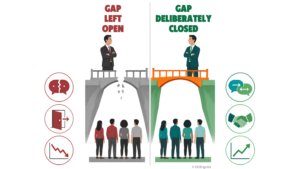
The Consequences of an Unaddressed Leadership Management Gap
An unaddressed leadership management gap produces measurable, wide-ranging damage across every level of the organization. Research from Gallup consistently shows that managers account for at least 70% of the variance in team engagement — and engagement drives productivity, retention, safety, and quality. A broken bridge between senior leadership and management therefore multiplies damage across every team simultaneously.
| Consequence | What It Looks Like | Why It Happens |
|---|---|---|
| Decision-making decay | Executives decide on filtered, sanitized information | The filtering effect compounds unchecked |
| Execution drag | Strategy becomes unrecognizable at the front line | Each layer reinterprets priorities to protect itself |
| Engagement collapse | Managers disengage, and their teams follow within months | Gallup links manager engagement directly to team engagement |
| Talent flight | The strongest managers and specialists leave first | High performers have options and low tolerance for incoherence |
| Toxic culture vacuum | Backbiting, blame, and survival behavior spread | No trusted channel exists to surface or resolve issues |
| Succession failure | Pipeline of future leaders runs dry | Managers cannot grow when bypassed and unheard |
The least visible consequence is the most dangerous: learned silence. When managers conclude that speaking up changes nothing, the organization loses its early-warning system. Problems surface only when they are catastrophic – and by then, the leadership management gap has been quietly writing that ending for years. Succession planning also suffers directly, as our article on Succession Planning Redefined: Find Future Leaders Fast explores in depth.
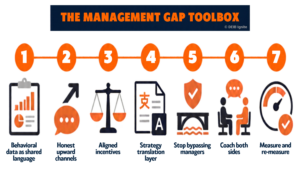
Seven Practices to Close the Leadership Management Gap
Closing the leadership management gap is not about scheduling more meetings – it is about deliberate behavioral and structural practices that change how information flows and how trust is built between levels. Here are the seven highest-leverage interventions, grounded in proven practice.
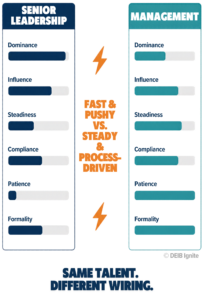 1. Make Behavioral Data the Shared Language
Run both senior leaders and managers through a validated behavioral assessment such as the Predictive Index Behavioral Assessment. Map the executive team profile against the management layer profile. Where are the friction points? Naming differences with valid data converts blame into understanding. This is the single highest-leverage intervention. The full methodology is in our pillar article: Behavioral Profiling for Success: The 2% Edge Explained.
2. Build Honest Upward Channels
Create structured, safe mechanisms for managers to deliver unfiltered reality upward. Practical tools include skip-level listening sessions with clear no-retaliation norms, anonymous pulse surveys with published follow-up actions, and decision post-mortems where the quality of upward information – not the comfort of the message – is actively celebrated.
3. Align Incentives Across Both Levels
Audit whether your performance and reward systems pull senior leadership and management in the same direction. If leadership is bonused on transformation speed and managers on stability, redesign around shared outcomes – engagement, retention, and execution quality – rewarded at both levels simultaneously. Misaligned incentives are a gap-builder hiding in plain sight.
 4. Translate Strategy, Not Just Communicate It
Every strategy message should include a translation layer: what this means for teams, what changes now, what does not change, and what managers are empowered to decide locally. Managers should never first hear about executive decisions from the rumor mill. Additionally, every translation layer should be co-created with managers, not handed down to them.
5. Stop Unsolicited Interventions
Make bypassing the management layer a governance exception, not a habit. When senior leaders must intervene directly in a team, do so with the manager – not around them. Every bypassed manager becomes a future filter. Therefore, protecting managerial authority is not just a courtesy – it is a structural investment in information quality.
6. Coach Both Sides of the Divide
Executive coaching for senior leaders should include how their behavioral drives land on the layer beneath them. Management development should include how to communicate upward with courage and clarity. Coaching both sides simultaneously is dramatically more effective than coaching either side alone. Courage in Leadership: Your Most Underused Success Resource explores exactly why that upward voice matters so much.
7. Measure the Gap — Then Re-Measure
Treat the divide as a metric: manager engagement scores, strategy comprehension checks, retention among managers, and upward-feedback quality. Harvard Business Review’s research on organizational culture and performance underscores that measured, managed culture change consistently outperforms aspirational culture change. What gets measured gets closed – and what gets closed compounds in your favor.

Frequently Asked Questions
What is the leadership management gap?
The leadership management gap is the structural and behavioral distance between senior leadership and management – visible as misaligned priorities, filtered communication, and mutual misreading of intentions. It causes strategy to lose integrity as it travels through the organization. The gap is measurable through behavioral data and engagement metrics, and it is closable with deliberate, sustained practice across both levels.
How do you know if your organization has a leadership management gap?
The warning signs are consistent: managers hear about executive decisions late or secondhand, upward information feels polished and safe rather than honest, change initiatives stall in the middle layer, senior leaders describe managers as resistant, and managers describe leaders as disconnected from operational reality. A validated behavioral profile comparison between both levels often makes the gap visible for the very first time.
Why does the leadership management gap develop in the first place?
The leadership management gap develops through the filtering effect of layered communication, different pressures and realities at each level, misaligned incentive structures, trust-eroding interventions from the top, and a lack of behavioral self-awareness on both sides. None of these dynamics requires bad intent – which is precisely why the gap is so common, so costly, and so consistently underestimated until it becomes a crisis.
What are the main consequences of ignoring the leadership management gap?
Ignoring the leadership management gap produces decision-making decay, execution drag, manager and team disengagement, talent flight, and a culture vacuum that toxic behaviors rapidly fill. Gallup attributes around 70% of team engagement variance to managers – so a broken relationship between leadership and management multiplies damage simultaneously across every team in the organization, compounding quarter by quarter.
How does behavioral profiling help close the leadership management gap?
Behavioral profiling through the Predictive Index platform gives senior leaders and managers a valid, shared language for their natural drives, stress responses, and behavioral blind spots. Instead of interpreting each other as difficult or resistant, both levels can see precisely where and why their behavioral patterns collide – and adapt deliberately. That shared self-knowledge, applied consistently, is the 2% edge that separates high-execution organizations from the rest.